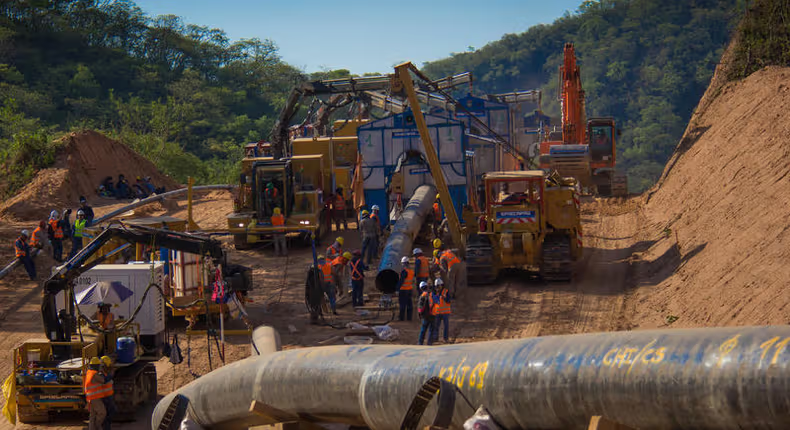
Uganda and Tanzania now expect EACOP oil exports to begin in October 2026—marking East Africa’s long-awaited entry into global oil markets. The announcement follows rapid progress on the $5 billion East African Crude Oil Pipeline (EACOP), which is now about 80% complete.
Stretching 1,443 kilometers from Uganda’s Albertine Graben to Tanzania’s Tanga port on the Indian Ocean, EACOP will become the world’s longest heated crude oil pipeline. It will transport Uganda’s waxy crude at around 50°C to maintain flow. At full capacity, it will carry up to 230,000 barrels per day for export via tankers.
Officials from both countries confirmed the timeline during a high-level meeting in Dar es Salaam on January 5, 2026. Energy ministers Ruth Nankabirwa (Uganda) and Deogratius Ndejembi (Tanzania) reviewed construction progress, above-ground facilities, and the marine terminal at Tanga. They set July 31, 2026, as the target for operational readiness—paving the way for first exports three months later.
Ernest Rubondo, CEO of Uganda’s Petroleum Authority, called EACOP “the backbone of Uganda’s crude oil exports.” The pipeline is central to unlocking the country’s estimated 6.5 billion barrels of recoverable reserves. For decades, these resources remained stranded due to lack of export infrastructure.
Meanwhile, Tanzania stands to gain significantly. The project has already generated 50 billion Tanzanian shillings ($19.5 million) in taxes and levies. It has also created about 1,200 local jobs—many in the Tanga region near the Chongoleani terminal. As a result, Tanzania is cementing its role as a regional energy transit hub.
Construction is now at peak intensity. All pipeline segments have been laid, and $3.3 billion of the total $5 billion investment has been spent. Developers—including TotalEnergies and China National Offshore Oil Company (CNOOC)—are finalizing pump stations, valve sites, and the export terminal.
However, success hinges on two factors: stable global oil prices and timely completion of upstream oil fields. Without sufficient production from Ugandan wells, the pipeline cannot reach full capacity.
Environmental groups continue to criticize EACOP over climate and human rights concerns. In response, officials highlight mitigation efforts. Notably, most pipeline operations will run on solar power—a move aimed at reducing emissions.
For East Africa, the EACOP oil exports represent more than energy revenue. They signal a strategic shift toward infrastructure-led growth, job creation, and deeper regional integration. If managed responsibly, the project could transform both economies for decades.
READ: Three-Quarters of $5 Billion East Africa Crude Oil Pipeline Complete