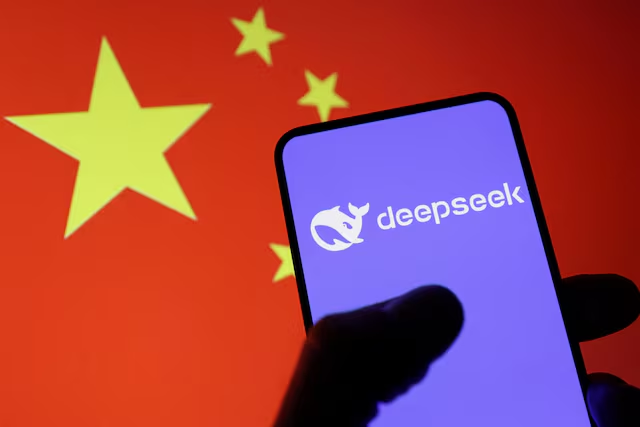
As China prepares for the Lunar New Year holiday starting Sunday, a wave of artificial intelligence activity is sweeping the tech sector. Rivals to DeepSeek are rushing to release or announce new Chinese AI models, hoping to seize attention before the festive pause—and avoid being caught off guard again during Spring Festival.
DeepSeek ignited this competitive surge last year with its breakthrough R1 and V3 models. Now, according to The Information, the Hangzhou-based startup is poised to launch its next-generation V4 model. This has triggered a flurry of counter-moves across the industry, with major players unveiling upgrades just days before the holiday.
DeepSeek itself stoked anticipation this week by expanding its chatbot’s “context window” from 128,000 to 1 million tokens. As a result, the system can now process book-length text in a single query—significantly boosting its utility for complex tasks. Observers also await the rumored R2 model, the successor to R1.
Bytedance, maker of TikTok, responded swiftly. On Saturday, it launched Doubao 2.0, claiming its reasoning and multi-step task execution rival OpenAI’s GPT 5.2 and Google’s Gemini 3 Pro. Doubao already leads China in weekly active users among AI chatbots, per Quest Mobile. Earlier in the week, Bytedance also released Seedance 2.0, a video-generation model that went viral on Chinese social media and drew praise—even from Elon Musk. It can produce cinematic-quality videos from minimal prompts. On Friday, the company added Seedream 5.0 Lite, a new image-generation model.
Alibaba, the first to counter DeepSeek’s rise last year with Qwen 2.5-Max, is now preparing Qwen 3.5. The e-commerce giant recently spent $400 million on a coupon campaign to promote “agentic commerce,” where AI handles online shopping. The push generated over 120 million consumer orders in six days, fueling domestic adoption of its Qwen app.
Zhipu AI, one of China’s so-called “AI tigers,” released its open-source GLM-5 model on Wednesday. It features stronger coding skills and supports long-running agent tasks. Having gone public in Hong Kong last month, Zhipu plans a secondary listing in Shanghai. Its stock has surged alongside peer MiniMax, reflecting investor confidence in China’s AI boom.
MiniMax, also newly listed in Hong Kong, unveiled its M2.5 open-source model on its overseas platform. The Shanghai-based firm has gained traction with apps like Hailuo AI (a video generator) and Talkie (an AI character interaction tool). Its IPO raised $620 million—more than Zhipu’s $558 million.
Tencent entered the race too. Its Hunyuan team released HY-1.8B-2Bit, a compressed AI model designed to run efficiently on consumer devices like smartphones.
Meanwhile, iFlytek launched Spark X2—trained entirely on Chinese-made chips—with a focus on real-world use in education, healthcare, and automotive sectors. NetEase Youdao introduced LobsterAI, a desktop agent that performs local workflows like scheduling and data analysis, with support for DingTalk and Feishu integration.
Finally, embodied-intelligence startup Dexmal unveiled DM0, an AI model built for robotics. It combines internet-scale multimodal data with navigation and robotic operation datasets, trained across multiple hardware platforms.
In summary, the pre-holiday rush reflects a broader strategic shift: Chinese tech firms are no longer waiting for global cues. Instead, they are aggressively shaping the future of Chinese AI models—on their own terms, and on their own timeline.
READ: Africa’s Manufacturing Future Takes Center Stage in Nairobi