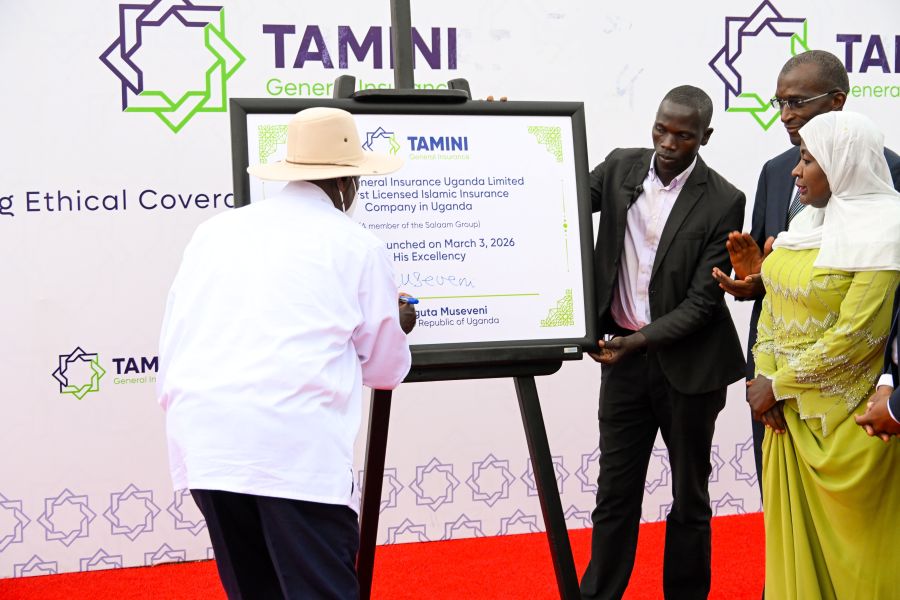
President Yoweri Museveni officially launched Tamini Islamic Insurance, Uganda’s first Sharia-compliant insurance firm, during an event in Kampala. The launch marks a major step toward expanding Islamic finance and improving financial inclusion in the country. Government leaders, Muslim community members, and financial sector stakeholders attended the ceremony at Millennium Park in Lugogo.
The event also coincided with an Iftar dinner organized by Hajjat Hadijah Namyalo, the Senior Presidential Advisor on Political Affairs and Head of the NRM National Chairman’s Office. During the gathering, President Museveni welcomed Salaam Group, the parent company behind Tamini Islamic Insurance, and encouraged the Muslim community to invest in productive economic activities.
According to the President, Uganda offers strong economic potential for investors. He pointed to the country’s growing population as a key factor that makes Uganda an attractive market for financial services. Currently, Uganda has more than 45 million people. However, projections show that the population could reach 100 million by 2050. Therefore, Museveni emphasized that financial institutions entering the Ugandan market are doing so at the right time.
The new Tamini Islamic Insurance company operates under Sharia principles. Unlike conventional insurance, Islamic insurance follows a cooperative model that promotes shared responsibility and mutual protection. Participants contribute to a pool that protects members against losses. As a result, the system avoids interest-based transactions and promotes ethical investment practices.
President Museveni praised Salaam Group for introducing financial services that target both low-income and middle-income earners. He explained that insurance plays a crucial role in supporting economic activity. According to him, people often borrow money to invest in businesses or agriculture. However, unexpected risks can threaten those investments. Therefore, insurance offers protection that helps maintain economic stability.
The President noted that Tamini Islamic Insurance completes an important financial cycle in Uganda’s growing Islamic finance ecosystem. For example, Salaam Bank already provides Sharia-compliant financing. Now, customers who receive Halal financing can also protect their investments through Islamic insurance coverage.
Museveni also encouraged the Muslim community to focus on productive investments rather than excessive consumption. He explained that wealth creation depends on investing in sectors that generate income and employment. Agriculture, manufacturing, and trade remain key areas where communities can build long-term economic growth.
In addition, the President highlighted the government’s poverty reduction programs. He referred to the Parish Development Model as an important initiative aimed at helping Ugandans transition from subsistence living to participation in the money economy. According to Museveni, the program provides financial support to local communities while promoting sustainable development.
The government charges a small annual fee on Parish Development Model funds. However, Museveni clarified that the six percent charge does not represent conventional interest. Instead, the fee helps control inflation and maintain the stability of the program’s revolving funds. Therefore, he urged communities, including Muslims, to utilize the initiative to improve livelihoods.
During his remarks, Museveni also addressed the selection of beneficiaries for development funds. He directed Parish Development Model committees to adopt a matrilineal approach when identifying beneficiaries. In a matrilineal system, family connections follow the female lineage. Consequently, this approach ensures broader inclusion of families, especially in polygamous households where some women-led families might otherwise face exclusion.
The President also praised women for their strong role in economic activities across Uganda. According to him, women often reinvest income into their families and communities. Therefore, empowering women economically strengthens both households and the national economy.
To further support Muslim families, Museveni pledged to increase funding for Muslim women’s economic initiatives. The government plans to raise the support fund from two billion shillings to approximately twenty billion shillings. As a result, many families may gain better access to financial opportunities and business development.
Meanwhile, Tamini Insurance leadership outlined the company’s vision for Uganda. Mohamed Bahdon, Group Chief Executive Officer of Tamini Insurance, explained that the firm will operate based on three core pillars. These pillars include ethical investment, transparent oversight, and collective participation. Together, these principles aim to strengthen trust within the financial system.
Bahdon emphasized that Tamini Islamic Insurance will play an important role in advancing financial inclusion. Many people in Uganda remain outside traditional insurance coverage. However, Sharia-compliant insurance could attract new customers who previously avoided conventional financial products.
He also explained how the model integrates with Islamic banking services. For instance, a farmer who receives Halal financing from Salaam Bank can insure crops or agricultural investments through Tamini Insurance. As a result, farmers gain protection against risks such as crop failure or natural disasters.
Bahdon believes this integrated financial system could support Uganda’s broader development strategy. By promoting ethical finance and risk protection, the model may help shift Uganda from a consumption-driven economy toward a production-oriented economy.
The Insurance Regulatory Authority also welcomed the introduction of Islamic insurance in Uganda. The authority’s Chief Executive Officer, Alhaji Ibrahim Kaddunabbi Lubega, said the country’s insurance sector continues to expand steadily. Currently, the sector has grown to more than two trillion shillings in value.
Lubega explained that the introduction of Tamini Islamic Insurance could accelerate growth in the industry. Globally, the Islamic insurance market continues to expand rapidly. The sector currently holds an estimated value of more than 36 billion dollars. Experts expect the global market to exceed 75 billion dollars by 2033.
Uganda’s entry into the Sharia-compliant insurance market therefore creates new opportunities for investors and consumers. Financial experts believe the model could strengthen Uganda’s position within Africa’s growing Islamic finance sector.
Hajjat Hadijah Namyalo also addressed guests during the event. She explained that Tamini Islamic Insurance will focus on underserved communities. In particular, the company plans to serve informal sector workers such as market vendors. Additionally, the firm aims to support communities that face frequent disasters or economic risks.
By targeting these groups, Tamini hopes to expand insurance coverage beyond traditional urban markets. Consequently, more Ugandans may gain access to financial protection and economic security.
The event also featured remarks from Sheikh Muhammad Yunus Kamoga, a leader within the Tabliq Muslim community. He thanked President Museveni for previously pardoning individuals who had faced legal challenges, including himself and businessman Hajji Muhammad Ssebuufu.
Kamoga also requested the President to consider granting clemency to two Muslim leaders currently under detention. Furthermore, he praised Museveni for promoting unity among Muslim communities in Uganda.
He also commended the government for supporting Muslim education institutions and financial initiatives. According to him, such support strengthens religious inclusivity and helps build stronger communities.
The launch of Tamini Islamic Insurance therefore represents more than just a new financial institution. It reflects a broader effort to expand financial inclusion, encourage ethical investment, and support economic transformation in Uganda. As Islamic finance continues to grow globally, Uganda now joins the list of countries exploring Sharia-compliant financial services as part of their economic development strategies.