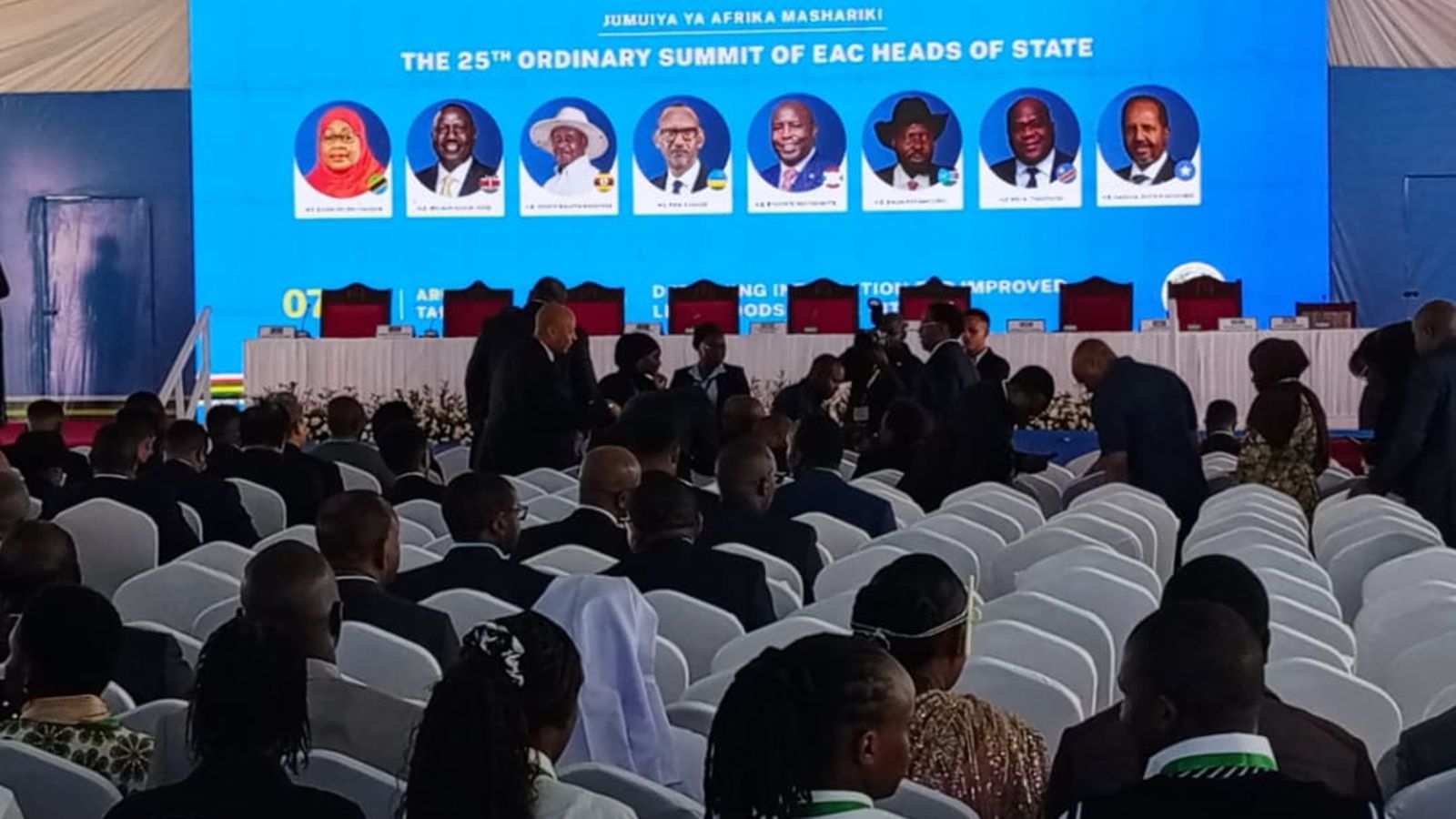
The EAC Summit reforms announced at the 25th Ordinary Summit of the East African Community Heads of State signal a major shift in how the regional bloc will operate. Leaders gathered in Arusha on March 7 and agreed on a set of measures aimed at restoring financial stability and accelerating regional integration.
Outgoing chairperson President William Ruto led the discussions and declared that the summit’s decisions would remain binding. He stressed that no other decision-making body within the community should challenge the resolutions. According to the summit communiqué, member states must implement the reforms without reopening them for further debate.
The EAC Summit reforms include a significant change in the bloc’s decision-making process. Leaders agreed to move away from the principle of consensus. Instead, the community will now adopt a system based on simple majority representation.
This shift addresses long-standing challenges that slowed regional integration. Under the previous system, decisions often stalled when member states failed to reach unanimous agreement. The new approach aims to prevent such delays and allow institutions to act more efficiently.
The summit also approved a new quorum requirement for meetings of all EAC organs and institutions. Two-thirds of member states must now attend meetings for decisions to proceed. Leaders believe this rule will reduce procedural obstacles and improve governance across the organization.
Financial reforms formed another major element of the EAC Summit reforms. Heads of state agreed to replace the existing equal contribution model with a hybrid financing formula. The new approach links member state contributions more closely to their economic capacity.
Under the new system, partner states will finance the EAC budget using two components. Half of the contribution will remain equal among all member states. The other half will depend on each country’s economic strength.
The assessed contribution will rely on real gross domestic product data. This method uses verified economic statistics, making the calculation process transparent and straightforward. Leaders selected GDP because international organizations regularly publish and verify the data.
The hybrid financing model also includes safeguards to maintain fairness. Contributions cannot exceed a ceiling of 30 percent for any single member state. At the same time, contributions cannot fall below a floor of 10 percent.
These limits prevent any country from carrying an excessive share of the financial burden. They also ensure that smaller economies contribute a meaningful amount to the community budget.
This system resembles financing mechanisms used by other regional organizations. Both the Southern African Development Community and the Common Market for Eastern and Southern Africa use similar contribution frameworks.
The EAC Summit reforms come at a time when the organization faces financial pressure. For the 2025/26 financial year, the EAC budget stands at approximately $109.3 million. Member states currently finance about $67.7 million of that amount, while development partners provide the remainder.
Beginning in July 2026, half of that $67.7 million contribution will divide equally among the eight partner states. If the budget remains unchanged, each country will contribute roughly $4.2 million for this portion.
The remaining half will follow the assessed formula based on economic capacity. Estimates suggest Kenya will contribute the largest share. Tanzania and Uganda will follow, while Rwanda will contribute a smaller but significant portion.
Countries with smaller economies such as Burundi, South Sudan, Somalia, and the Democratic Republic of Congo will pay lower percentages within the permitted range.
Despite the financial reforms, arrears remain a serious concern. Several partner states have accumulated large unpaid contributions. The Democratic Republic of Congo currently holds the largest outstanding balance, followed by Burundi, South Sudan, and Somalia.
To address this challenge, leaders introduced a temporary measure. The EAC Summit reforms include a one-time waiver of 50 percent of all arrears owed by member states. However, the remaining balance must be paid within two years.
Leaders agreed to impose sanctions on states that fail to comply with the new system. The Council of Ministers will develop an enforcement framework and present it at the next summit.
The summit also approved institutional reforms affecting regional governance. Member states will now pay the salaries of their representatives in the East African Legislative Assembly through national parliaments. Meanwhile, staff at the EAC Secretariat will receive a two percent salary increase beginning in January 2027.
Another reform limits eligibility for key leadership positions within the community. Only citizens of partner states that fully meet their financial obligations will qualify for senior roles.
These roles include the Speaker of the East African Legislative Assembly, the President of the East African Court of Justice, the Secretary-General, and deputy secretaries-general.
The EAC Summit reforms also influenced leadership transitions within the organization. Uganda’s President Yoweri Museveni assumed the position of chairperson of the Heads of State Summit.
The appointment followed the rotational leadership structure used by the community. However, the decision also reflected the fact that some member states have not yet completed key integration requirements.
The summit also appointed Tanzanian technocrat Stephen Patrick Mbundi as the new Secretary-General of the East African Community. Leaders chose Mbundi to succeed Kenya’s Veronica Nduva and guide the secretariat during a challenging period.
Mbundi brings extensive experience in regional diplomacy and integration policy. Before his appointment, he served as a permanent secretary in Tanzania’s Ministry of Foreign Affairs and East African Cooperation.
In that role, he coordinated Tanzania’s participation in regional institutions and negotiations. His work placed him at the center of many high-level EAC consultations and policy discussions.
Leaders believe his experience will help restore momentum toward deeper political and economic integration. Supporters say his familiarity with the community’s internal processes will strengthen institutional continuity.
The EAC Summit reforms also addressed trade barriers within the region. Heads of state directed the Council of Ministers to resolve all reported non-tariff barriers by June 30.
The East African Business Council welcomed the directive. Its leadership stated that stronger policy coordination could create new commercial opportunities for businesses operating within the region.
Private sector representatives believe the reforms could expand trade and investment if implemented effectively. However, some legal experts warn that certain changes may require amendments to the EAC treaty.
Critics argue that the treaty still mandates equal contributions from partner states. Without formal legal revisions, they say courts could challenge the new financing formula.
Despite these concerns, many observers view the reforms as long overdue. Supporters believe the changes could strengthen the East African Community and improve its ability to pursue economic and political integration.
As the new leadership begins its term, expectations remain high. Leaders across the region now face the challenge of translating the EAC Summit reforms into practical action that benefits both governments and citizens.