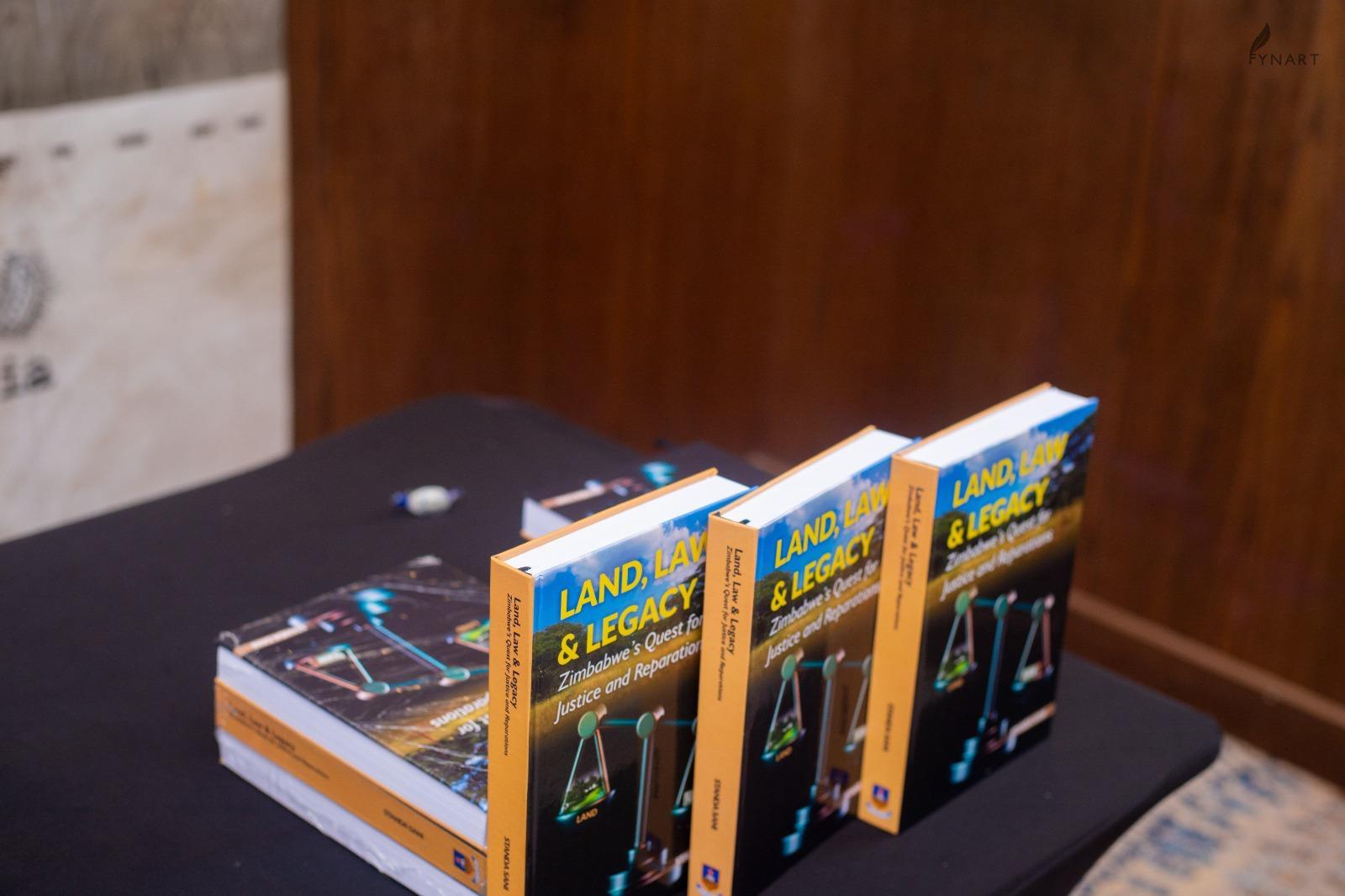
Zimbabwe land reform book Land, Law & Legacy: Zimbabwe’s Quest for Justice and Reparations by legal scholar and author Standa Sani offers a detailed examination of one of the most important questions in the country’s history: how land, law and justice intersect after colonial dispossession.
The publication revisits Zimbabwe’s land question through a broad framework that includes legal history, colonial policy, moral philosophy, reparations, Pan-Africanism and comparative land reform. It examines how land ownership became one of the defining issues in Zimbabwe’s struggle for liberation and post-independence nation-building.
“Where law has been used to create injustice, justice must begin by questioning the law. Historical injustice is not erased by time; it is either confronted through justice or preserved through legality. Reparations are not about the past alone, but about the future that becomes possible when the past is no longer denied.” — Standa Sani.
Sani’s book argues that the land question cannot be understood only through modern property disputes or political controversy. It must be traced back to the colonial laws and systems that removed indigenous communities from ancestral lands and created racialised patterns of land ownership.
By connecting history with law and justice, Land, Law & Legacy seeks to deepen public understanding of why land remains central to Zimbabwe’s national identity, economic development and search for reconciliation.
The book is written for scholars, policymakers, legal practitioners, students and general readers interested in land governance, constitutionalism, reparations and historical justice.
A Study of Land, Law and Historical Injustice
At the heart of the book is a legal study of how colonial dispossession was created and maintained.
Sani examines the role of colonial legislation in shaping Zimbabwe’s land ownership system. The book analyses laws such as the Land Apportionment Act of 1930, the Native Land Husbandry Act of 1951 and the Land Tenure Act of 1969.
These laws institutionalised racial separation and unequal access to land. They restricted indigenous Zimbabweans while protecting settler access to some of the most productive land. In doing so, colonial law became a tool for dispossession.
The book shows that the land question was not produced by isolated events. It was built through a system of legislation, administration and racial power. This legal foundation, Sani argues, is essential to understanding later debates about land reform and reparations.
The work also considers legal developments such as the Privy Council judgment and their influence on land tenure questions in Zimbabwe. This makes the book especially relevant to readers interested in how courts and colonial legal systems shaped property relations.
Why Zimbabwe’s Land Question Remains Unresolved
Zimbabwe’s land question remains powerful because land carries historical, social and economic meaning.
For many communities, land is connected to ancestry, identity, dignity and belonging. It is also tied to livelihoods, agriculture, food security and wealth creation. This combination explains why land continues to shape Zimbabwe’s politics and public debate.
Land, Law & Legacy presents land dispossession as a historical wrong with continuing consequences. Political independence did not automatically erase the social and economic effects of colonial land policies. Unequal ownership patterns, inherited grievances and unresolved questions of redress continued to influence the postcolonial state.
Sani’s book therefore places land at the centre of national healing. It asks whether reconciliation can be meaningful if historical land dispossession is not fully acknowledged and addressed.
This approach gives the publication wider importance. It presents land reform not simply as a policy question, but as part of Zimbabwe’s continuing search for justice.
Reparations as a Pathway to Historical Accountability
A major theme in the book is reparations.
Sani explores reparations as a response to historical injustice, particularly where land was taken through colonial conquest, racial law and political domination. The book presents reparations as more than financial compensation. It also connects them to acknowledgement, responsibility, dignity and meaningful repair.
This wider understanding of reparations is important because land dispossession affected more than ownership. It shaped communities, livelihoods, culture, status and opportunity. For that reason, the book argues that redress must also be understood in moral and social terms.
The publication draws on philosophical ideas, including Aristotelian principles of justice, to examine what fairness requires after historical wrongdoing. It asks how a society can respond to inherited injustice while building a stable and inclusive future.
By placing Zimbabwe’s land debate within the broader reparations discourse, Sani connects the country’s experience to wider global conversations about colonialism, racism and historical responsibility.
Britain’s Responsibility in Zimbabwe’s Land History
One of the central arguments in Land, Law & Legacy concerns Britain’s role in Zimbabwe’s land history.
Sani contends that Britain bears moral and historical responsibility for the consequences of colonial land policies. The book argues that racial segregation, land dispossession and the subjugation of indigenous communities were not accidental outcomes. They were part of a colonial system supported by law and imperial authority.
This argument gives the book a strong contemporary relevance. Around the world, former colonial powers face renewed calls to acknowledge and address the damage caused by colonial rule. In Zimbabwe’s case, land remains one of the most direct and visible legacies of that history.
The book frames Britain’s responsibility as part of a wider justice conversation. It asks what acknowledgement and repair should mean when historical land policies continue to shape present realities.
By raising this issue through legal and moral analysis, Sani contributes to a serious debate about accountability, reparations and the unfinished business of decolonisation.
Fast Track Land Reform Programme Revisited
The book also examines Zimbabwe’s Fast Track Land Reform Programme, launched in 2000.
The programme dramatically changed land ownership patterns and remains one of the most debated developments in Zimbabwe’s post-independence history. It is viewed by some as a necessary correction to colonial injustice and by others as a policy that carried serious economic, legal and social consequences.
Sani’s book engages with both sides of the issue. It recognises the historical necessity of land redistribution while also examining the effects of the programme on displaced white commercial farmers, agricultural output, livelihoods and social relations.
This balanced treatment is one of the book’s key strengths. It does not discuss land reform in isolation from the colonial past, but it also does not ignore the difficult questions raised by implementation and outcomes.
By placing the Fast Track Land Reform Programme within a longer legal and historical timeline, Land, Law & Legacy helps readers understand why the issue remains deeply contested.
Comparative Land Reform Lessons
Sani expands the discussion by comparing Zimbabwe’s land reform experience with other countries.
The book examines land reform and historical justice debates in South Africa, Namibia, Eswatini and Australia. These comparisons show that Zimbabwe is part of a wider global and regional conversation about land, restitution and colonial legacy.
South Africa and Namibia continue to face significant land inequality rooted in colonial and apartheid histories. Eswatini offers another Southern African perspective on land governance. Australia brings into focus questions of indigenous dispossession, recognition and repair.
Through these comparisons, the book shows that land reform is never simple. It must balance justice, productivity, social stability, legal certainty and national reconciliation.
The comparative approach gives the publication value beyond Zimbabwe. It offers lessons for other countries seeking to address land dispossession and historical inequality.
Pan-Africanism and the Liberation Struggle
Land, Law & Legacy also situates Zimbabwe’s land question within the wider history of African liberation and Pan-Africanism.
The book examines the role of the Organisation of African Unity and the African Union in supporting liberation struggles and promoting African sovereignty. This context matters because land was central to the struggle against colonial rule across Southern Africa.
For many liberation movements, land was not only an economic demand. It represented freedom, dignity and self-determination. Reclaiming land was part of reclaiming control over national destiny.
By linking the land question to Pan-African history, Sani presents Zimbabwe’s experience as part of a broader continental struggle against colonial domination and racial injustice.
A Book for Legal and Public Debate
Land, Law & Legacy is designed to speak to both specialist and general audiences.
Legal scholars and practitioners will find detailed discussion of land law, property rights, constitutional questions and reparative justice. Policymakers can use the book to reflect on the design of land governance systems and the long-term consequences of reform.
Students of law, history, politics, human rights and development studies will find it useful as a guide to one of Zimbabwe’s most significant national issues.
General readers will also benefit from the book because it explains the land question in accessible terms while preserving its legal and historical depth.
The book’s public value lies in its attempt to move the debate beyond polarisation. It encourages readers to examine evidence, history and justice rather than relying only on political slogans.
Author’s Purpose
Sani says the book was written to encourage a more informed and balanced conversation about Zimbabwe’s land question.
“This book seeks to contribute to an informed and balanced understanding of Zimbabwe’s land question by examining its historical foundations, legal dimensions, and implications for contemporary justice and reparations discourse,” said Sani.
That statement reflects the book’s central aim. It is not only a study of the past. It is also a contribution to present and future debates about justice, reconciliation and national development.
About Standa Sani
Standa Sani is a Zimbabwean legal scholar, author and registered legal practitioner.
His work focuses on constitutional law, land law, succession law, property law, human rights and historical justice. Through his scholarship, legal practice and publications, he contributes to debates on land governance, reparations and transformative justice in Zimbabwe and beyond.
Land, Law & Legacy: Zimbabwe’s Quest for Justice and Reparations adds to his work on law, justice and historical accountability.
Book Availability
Land, Law & Legacy: Zimbabwe’s Quest for Justice and Reparations is available for purchase through the Faculty of Law, University of Zimbabwe, and directly from the author.
Media, Speaking Engagement and Book Purchase Enquiries
Standa Sani
Email: [email protected]
Email: [email protected]
Conclusion
Zimbabwe land reform book Land, Law & Legacy: Zimbabwe’s Quest for Justice and Reparations offers a timely and thoughtful examination of land, law and historical justice.
By analysing colonial legislation, land dispossession, reparations, Britain’s responsibility, the Fast Track Land Reform Programme and comparative reform experiences, Standa Sani provides a broad framework for understanding Zimbabwe’s land question.
The book’s main message is clear: land is not only about property. It is about justice, identity, dignity, memory and national healing.
For readers seeking a deeper understanding of Zimbabwe’s land reform debate and the continuing call for reparations, Land, Law & Legacy is an important contribution to one of Africa’s most consequential conversations.